
As a culture we've completely immersed ourselves in this digital world, begging to be noticed. Some of us are in way over our heads simply trying to stay afloat (see also: checking into Foursquare every time you leave the couch), while others are standing in puddles not only confused as to where they are, but also are wondering what it is exactly that they're standing in (see also: your mother leaving you voicemails telling you that she just joined 'the twitters' and needs your help – great).
The bottom line is that everyone has a story that they want to tell...only they don't just want to say it to just one person – they want to yell it to the world.
So, before you plant your social media seeds that you got by trading the old cow that your mother told you to go sell at the market, you have two very important things to consider: what is your message and who is your audience.
Thought that was the hard part? Think again. Now you have to figure out the best way to get that message to your audience.
There are more social media sites out there than there are pizza-topping combinations at Domino's. So, you'll have to do a bit of research - because just like pizza toppings, everyone has different taste.
Sure, some are more popular than others, but that doesn't mean that the others are necessarily bad. Everyone has their own personal needs and it all comes down to your own personal preference. Sometimes less is more and other times more is better. You have to choose what works best for you.
... after all, this is your story.
Showing posts with label internet marketing. Show all posts
Showing posts with label internet marketing. Show all posts
Wednesday, April 21, 2010

Thursday, April 8, 2010
Using Facebook Widgets to Your Advantage
So you're company is on Facebook. Great! But are you getting the most out of Facebook? Remember, Facebook is totally free and has over 300 million users, so why not make the best of an already great situation by using its tools to your advantage? One way to do this is by utilizing Facebook's widgets.
Available widgets and how to set them up can be found here, but here's a quick break down of what they do and what they can accomplish:
Share Button - This allows people to post content from your site back to Facebook. This is one of the most commonly used widgets out there and you'd be hard-pressed to find a site that wasn't using this (or other share tools.) But why use this feature instead of just letting the reader copy and paste a link whenever they feel inclined to do so? With the Share Widget, you're not just making it easier for people to share content from your site on Facebook, but you're subtly suggesting they share it as well. Additionally, even if that shared content isn't clicked on in Facebook, people still see the URL its coming from. That alone serves as an excellent branding opportunity because whether people were looking for your website or not, it just made an impression. There's also the added benefit of being able to share that content without navigating away from your site.
Fan Box - This widget is a great way to let visitors to your website know that you have a Facebook page. It provides a small stream of current status updates from your Facebook page and has a "Become a Fan" button so people can "fan" you right then and there while still staying put on your site. Here's a great tutorial we put together on how to add this widget to your site.
Page Badge - Think of a Page Badge as a toned-down version of the Fan Box widget. It too is made to go on your site and it too let's people know that you have a Facebook page. However, it doesn't contain a feed and it doesn't have the "Become a Fan" button. Instead, it's a cleaner, simpler presentation that contains just the basics: your page name, most recent status update, and the number of fans you have.
Twitter Link - Why post to two places when you can simply post to one? Twitter Link allows you to send your Facebook updates to Twitter automatically. This is a great time-saving tool, and you might just roundup some followers on Twitter who fan you on Facebook. Don't want to send everything you post to Twitter? No worries - you can adjust the settings when you link the two accounts.
With just a few clicks of your mouse and a little copying and pasting, you'll be well on your way to driving traffic back to your website, increasing the number of fans you have on Facebook, and saving yourself a little bit of time!
Available widgets and how to set them up can be found here, but here's a quick break down of what they do and what they can accomplish:
Share Button - This allows people to post content from your site back to Facebook. This is one of the most commonly used widgets out there and you'd be hard-pressed to find a site that wasn't using this (or other share tools.) But why use this feature instead of just letting the reader copy and paste a link whenever they feel inclined to do so? With the Share Widget, you're not just making it easier for people to share content from your site on Facebook, but you're subtly suggesting they share it as well. Additionally, even if that shared content isn't clicked on in Facebook, people still see the URL its coming from. That alone serves as an excellent branding opportunity because whether people were looking for your website or not, it just made an impression. There's also the added benefit of being able to share that content without navigating away from your site.
Fan Box - This widget is a great way to let visitors to your website know that you have a Facebook page. It provides a small stream of current status updates from your Facebook page and has a "Become a Fan" button so people can "fan" you right then and there while still staying put on your site. Here's a great tutorial we put together on how to add this widget to your site.
Page Badge - Think of a Page Badge as a toned-down version of the Fan Box widget. It too is made to go on your site and it too let's people know that you have a Facebook page. However, it doesn't contain a feed and it doesn't have the "Become a Fan" button. Instead, it's a cleaner, simpler presentation that contains just the basics: your page name, most recent status update, and the number of fans you have.
Twitter Link - Why post to two places when you can simply post to one? Twitter Link allows you to send your Facebook updates to Twitter automatically. This is a great time-saving tool, and you might just roundup some followers on Twitter who fan you on Facebook. Don't want to send everything you post to Twitter? No worries - you can adjust the settings when you link the two accounts.
With just a few clicks of your mouse and a little copying and pasting, you'll be well on your way to driving traffic back to your website, increasing the number of fans you have on Facebook, and saving yourself a little bit of time!
Thursday, March 25, 2010
Using Social Media To Control the Conversation
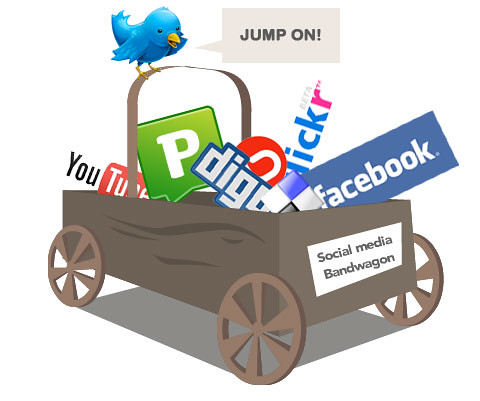
Many businesses hesitate to jump on the social media bandwagon because they're nervous. It's a far cry from sending out a press release or direct mailer. It's a different kind of networking from exchanging business cards in the elevator. It's something new, and it's something you cannot completely control. But as marketing strategist David Meerman Scott puts it, you have to lose control of your marketing in order for it to succeed.
To get started, many businesses and organizations want to know everything there is to know about social media and how to prevent anything that can possibly go wrong. However, the whole idea behind social media is that it's social. But sometimes business professionals need to be reminded of that – it's the people, the consumers who are in charge, not the business. When you have a presence and you're there to hear what they're saying, then you are there to steer the conversation.
Blogger Kaila Colbin recently wrote a great article for Media Post entitled Two Golden Rules For Companies On Social Media discussing why many businesses and organizations hesitate to start out in social media:
People will be complaining, in public, and these complaints will be visible to everyone, and other people who see those complaints might not like us anymore, and then the good times will be over. Providing a soapbox on which our customers can advertise their dissatisfaction runs counter to every protective instinct we have.But there are distinctive right ways and wrong ways to respond.
The problem, of course, is that those complaints are already being aired online. Anyone upset enough to go to your Facebook page and tell you what they don't like is upset enough to tell their friends and followers in your absence. Staying off social media doesn't stop the problem; it merely removes the discomfort of having to deal with it. Being on social media at least gives you the chance to respond.
The wrong way: what's happening with Nestle on Facebook.
Whether overwhelmed or underprepared, the company went on a counterattack - trading insults with its own Facebook fans and ‘unfriending’ them. It deleted threatening posts and modified logos, and posted a warning to users in the hope that it would deter them from sharing their views. Once the online ‘bullying’ got picked up on Twitter, it went global.Nestle's public image suffered because they didn't follow Colbin's golden rules:
1. Act With Integrity: The first rule isn't about turning your company into a group of enlightened monks or save-the-world superheros. Integrity is about being consistent. It's about (to use a horrible consultant phrase) living up to the brand promise. It's about making sure that what you see is what you get.Two companies that followed these rules, particularly #2, are Domino's and Southwest.
2. Admit Your Mistakes: We all mess up, especially on social media. But the optimal way to deal with a mistake is to admit it, take any steps necessary to correct the situation, and then move on.
Dominos had some very bad publicity last year, which got started on YouTube, and so CEO Patrick Doyle responded in the same medium where the problem occurred – YouTube. The video isn't highly produced – it's straight, to the point, no frills. But it does the job effectively.
Similarly, Southwest came under fire in February after an incident in which director Kevin Smith tweeted about being kicked off a flight due to his weight. Southwest is very active in social media, and less than 20 minutes after his initial tweet, Southwest responded with an apology. And multiple blog entries. Ten years ago, maybe even five years ago, they would have used traditional media such as a press release or press conference that wouldn't have had the same immediate and personal effect. Today, Southwest helped recover from a negative situation by responding efficiently and appropriately – using the right social media tools.
Both of these companies, while facing PR nightmares, used social media to try to make things right. They went directly to the source of the situations and used these channels as best they could. And most of these are circumstances that smaller businesses and organizations will never have to face. But what you can learn from these examples is that you have to be here to respond to the smaller problems that come up day-to-day.
Comcast is a great example of what social media can do to to improve your customer service reputation. Their use of Twitter to respond to customer complaints – not even those directed to them – has really made them a standout among social media success stories.
But how do you start from scratch? Unfortunately, there is no simple way to do this other than diving right into social media, headfirst. Not to say you need to immediately go sign up for Twitter, Facebook, MySpace, Flickr, LinkedIn, Digg and YouTube today. But if you get online and spend a little time watching the conversations happen, you can quickly and easily start learning where your customers/clients/members are already located, which of the many (and there are many) social media tools are best for your particular purpose and how they can work to your advantage.
Photo: Matt Hamm
Subscribe to:
Posts (Atom)

 Posts
Posts

